The job market has changed. Have your strategies?
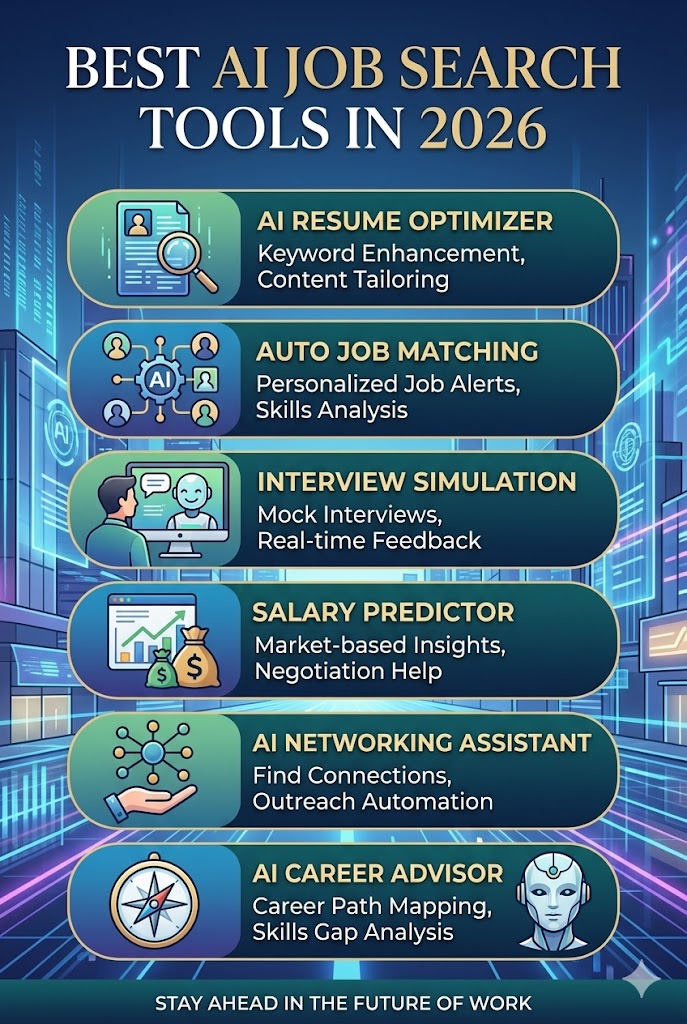
Landing a job today is no longer just about polishing your resume and crossing your fingers. With millions of applications flooding recruiters’ inboxes every day, the hiring landscape has become brutally competitive. The good news? Artificial intelligence is leveling the playing field — and if you know how to use the best AI job search tools available, you can dramatically cut your job search time, improve your application quality, and walk into interviews with more confidence than ever before.
Whether you’re a fresh graduate stepping into the workforce for the first time, a seasoned professional eyeing a career pivot, or someone who was recently laid off and needs to move fast, this guide is your comprehensive resource. We’re breaking down the top AI-powered tools that are transforming how people search for jobs, apply, prepare, and ultimately get hired.
Let’s dive in.
Why AI Job Search Tools Are No Longer Optional
Before we get into the tools themselves, it’s worth understanding why AI has become such a critical part of the modern job search.
Recruiters are overwhelmed. Studies show that a single job posting can attract anywhere from 100 to over 1,000 applications. Most hiring managers spend less than 10 seconds scanning a resume before deciding to move on. That’s where Applicant Tracking Systems (ATS) — software that filters resumes before a human ever sees them — come in. If your resume isn’t optimized for ATS, it might never even reach a recruiter’s desk.
The application process is exhausting. Customizing your resume and cover letter for every single job, researching companies, preparing for interviews, and following up — it’s practically a full-time job in itself. AI tools can handle much of this heavy lifting.
Personalization matters more than volume. Gone are the days when sending out 200 generic applications was a smart strategy. Today, targeted, personalized applications perform far better. AI tools help you tailor your materials quickly and intelligently.
Now, let’s look at the actual tools that can make this happen.
1. Jobscan — The ATS Optimization Powerhouse
Best for: Resume and LinkedIn optimization
If you only use one tool from this entire list, make it Jobscan. This AI-powered platform compares your resume directly against a job description and tells you exactly how well it matches — including which keywords you’re missing, how your formatting holds up against ATS software, and what changes will increase your chances of getting past the initial screen.
How it works: You paste in a job description and upload your resume. Jobscan’s algorithm analyzes both and generates a match score. The higher the score, the more likely your resume is to make it through an ATS filter. It also provides a breakdown of hard skills, soft skills, and industry buzzwords that the employer is prioritizing.
Why it stands out: Jobscan supports over 100 different ATS platforms, including Taleo, Workday, Greenhouse, and iCIMS — the systems used by most Fortune 500 companies. It also offers LinkedIn profile optimization, which is equally important since recruiters actively search LinkedIn for candidates.
Pricing: Free plan available with limited scans. Premium plans start at around $49.95/month.
Pro tip: Run every resume through Jobscan before submitting. Even small keyword tweaks can dramatically improve your match score and visibility.
2. Teal — Your All-in-One Job Search Companion
Best for: Organizing your job search and AI-powered resume building
Teal describes itself as a career growth platform, and it lives up to that billing. It combines a job tracker, resume builder, LinkedIn importer, and AI writing assistant into a single, beautifully designed dashboard.
Standout features:
- Job tracker: Teal lets you save job listings from across the web with a Chrome extension, then organize them by status (saved, applied, interview, offer). This alone is a game-changer for keeping your search structured.
- AI resume builder: The platform generates tailored resume bullet points based on your experience and the specific job you’re targeting. It pulls data from the job description to help you mirror the language employers are using.
- Resume scoring: Like Jobscan, Teal scores your resume and flags areas for improvement — from keyword gaps to formatting issues.
- LinkedIn profile importer: Build a resume in seconds by importing your existing LinkedIn data.
Why it stands out: Teal’s interface is intuitive and visually clean, making it especially appealing for people who feel overwhelmed by the chaos of a multi-platform job search. Having everything in one place — your saved jobs, applications, resume versions, and notes — removes a significant amount of friction.
Pricing: The core features are free. Teal+ (premium) is available for around $29/month and unlocks unlimited AI resume tailoring and additional insights.
3. Rezi — AI-Driven Resume Writing at Scale
Best for: Creating ATS-optimized resumes from scratch
Rezi is built specifically around one mission: helping you create resumes that beat ATS systems. Its AI analyzes job descriptions and either builds a resume from scratch or rewrites your existing one to match.
Key features:
- AI content suggestions: Rezi’s AI generates bullet points based on your role and industry. You provide the facts; it crafts the language.
- Real-time ATS analysis: As you write, Rezi gives you a live score showing how your resume stacks up against ATS requirements.
- Keyword targeting: The tool identifies high-priority keywords from any job description and guides you to incorporate them naturally.
- Resume templates: Dozens of clean, professional templates that are built to pass ATS filters — meaning no graphics, tables, or fancy fonts that tend to confuse automated systems.
Why it stands out: Rezi is especially useful for people who struggle with writing about themselves. The AI-generated content gives you a strong starting point that you can then personalize, rather than staring at a blank page.
Pricing: Free plan available. Pro plan starts at around $29/month.
4. LinkedIn’s AI Features — Don’t Overlook the Giant
Best for: Networking, job discovery, and profile optimization
LinkedIn has been aggressively rolling out AI-powered features, and if you’re not taking advantage of them, you’re leaving opportunities on the table.
Current AI tools within LinkedIn:
- AI-assisted job applications: LinkedIn’s AI helps you complete job applications faster by pulling data directly from your profile and tailoring it to the role.
- Profile writing suggestions: The platform offers AI-generated suggestions to improve your headline, summary, and experience sections.
- Job match scores: Premium members can see how well their profile matches a job posting, giving you a quick read before you invest time applying.
- InMail drafting: AI helps you craft outreach messages to recruiters and hiring managers — one of the most underused job search strategies.
- Interview prep: LinkedIn’s AI simulates interview questions based on the role you’re applying for and gives feedback on your answers.
Why it stands out: LinkedIn has the largest professional network in the world. AI features baked directly into a platform where recruiters already live is an incredibly powerful combination. Building a strong, AI-optimized LinkedIn profile is no longer optional — it’s table stakes.
Pricing: Many features are free, but LinkedIn Premium (starting at around $39.99/month) unlocks the most powerful AI tools.
5. Interview Warmup by Google — Practice Makes Perfect
Best for: Interview preparation and confidence building
Developed by Google as part of its Grow with Google initiative, Interview Warmup is a free AI tool that helps you practice answering interview questions out loud and get instant feedback.
How it works: You choose a job category (data analytics, project management, UX design, etc.), and the tool presents you with practice interview questions. You speak your answers aloud, and the AI transcribes them in real time. It then analyzes your responses, noting talking points you covered, job-relevant terms you used, and patterns in how you communicated.
Why it stands out: Most people don’t practice for interviews nearly enough, and when they do, they practice in front of a mirror or with a friend — both of which have significant limitations. Interview Warmup gives you a low-pressure, judgment-free environment to develop your responses and build muscle memory. The pattern recognition is particularly helpful — it can identify when you’re overusing filler words or when you’re consistently failing to mention certain key experiences.
Pricing: Completely free.
6. ChatGPT and Claude — The Swiss Army Knives of Job Searching
Best for: Cover letters, email drafting, research, and personalization at scale
General-purpose AI assistants like ChatGPT and Claude have become indispensable tools for job seekers who know how to use them. While they’re not dedicated job search platforms, they’re extraordinarily versatile and can be applied to nearly every stage of your search.
Practical applications:
- Cover letters: Provide the AI with the job description, your resume, and a few notes about why you’re interested. It will generate a compelling, customized cover letter in seconds. Always edit and personalize the output before sending.
- Company research: Ask the AI to summarize a company’s recent news, culture, and values before an interview. Walking in informed makes a powerful impression.
- Salary negotiation scripts: Role-play salary negotiations to build confidence and sharpen your arguments.
- Thank-you emails: Draft polished follow-up emails after interviews in minutes.
- LinkedIn connection messages: Craft personalized outreach to recruiters or potential referrals without sounding robotic.
- Job description decoding: Paste in a confusing or vague job description and ask the AI to break down what the company is really looking for.
Why they stand out: Flexibility. These tools can adapt to any job search scenario you throw at them. They’re also excellent for people who find writing difficult or stressful — having an AI produce a first draft removes the most intimidating part of the process.
Pricing: Both have free tiers. Paid plans (typically $20/month) unlock more powerful models and higher usage limits.
7. Kickresume — Beautiful Resumes with AI Brains
Best for: Creative professionals who need design + substance
Kickresume occupies a sweet spot between beautiful resume design and AI-powered content generation. It’s particularly popular among professionals in creative fields — marketing, design, communications — where the visual presentation of your resume matters as much as the content.
Key features:
- AI resume writer: Generates professional resume content based on your job title and experience level
- AI cover letter generator: Creates tailored cover letters that match the tone and language of the job description
- Stunning templates: 35+ professionally designed templates built for visual impact
- Website builder: Convert your resume into a personal portfolio website — a powerful differentiator in creative industries
- Grammar checker: Built-in proofreading catches typos and awkward phrasing before your resume goes out
Why it stands out: Most resume tools sacrifice aesthetics for ATS compatibility. Kickresume manages to offer visually appealing designs while still keeping ATS compatibility front of mind on their core templates.
Pricing: Free plan available. Premium starts at around $19/month.
8. Huntr — Smart Job Tracking with AI Assistance
Best for: Staying organized throughout a long job search
Huntr is a job search management tool with a Kanban-style board that lets you drag applications through stages — Saved, Applied, Phone Screen, Interview, Offer. It integrates AI to help you stay on top of follow-ups, deadlines, and application materials.
Key features:
- Job board scraper: Save jobs from any website with a click
- AI resume tailoring: Customize your resume for each role directly within the platform
- Contact tracking: Log contacts at each company and track your networking activity
- Task reminders: Never miss a follow-up or interview prep deadline again
Why it stands out: The organizational features here are genuinely best-in-class. For anyone juggling multiple applications simultaneously — which you absolutely should be — Huntr provides the structure needed to avoid the dreaded “Wait, did I actually apply to that?” moment.
Pricing: Free plan available. Pro plan is around $30/month.
Also read: Top Canadian Universities for International Students in 2026
How to Get the Most Out of AI Job Search Tools
Having the right tools is only half the battle. Here’s how to use them strategically:
Layer your tools. Use Teal or Huntr to organize your search, Jobscan or Rezi to optimize your resume for each application, ChatGPT or Claude for cover letters and research, and Interview Warmup to prepare for conversations. Each tool handles a different piece of the puzzle.
Always personalize AI output. AI tools are powerful, but they’re also generic. Every piece of AI-generated content — whether it’s a cover letter, a resume bullet, or an outreach message — needs to be reviewed and personalized before it goes out. Hiring managers can often spot AI writing that hasn’t been humanized.
Optimize your LinkedIn profile first. Before you spend time applying, make sure your LinkedIn profile is polished. Many recruiters find candidates proactively, so an optimized profile can bring opportunities to you rather than the other way around.
Treat the job search as a system, not a sprint. The people who find jobs fastest are usually those with the most organized, consistent processes. Set daily targets, track everything, and review your approach weekly.
Final Thoughts: Work Smarter, Not Harder
The best AI job search tools won’t find you a job on their own — but they will give you a significant competitive edge over applicants who are still doing everything manually. From ATS-beating resumes to AI-powered interview practice, the technology available today is genuinely remarkable.
Start with one or two tools, get comfortable with them, and then expand your toolkit as your search evolves. The goal isn’t to use every tool on this list — it’s to build a personalized, efficient system that plays to your strengths and addresses your weaknesses.
The job market is competitive, but it’s not unbeatable. With the right AI tools in your corner, you’re not just another applicant — you’re a well-prepared, strategically positioned candidate who knows how to stand out.
Good luck with your search. You’ve got this.
Have you tried any of these AI job search tools? Share your experience in the comments below — we’d love to hear what’s working for you.